













The joist: the invisible foundation of a successful deck
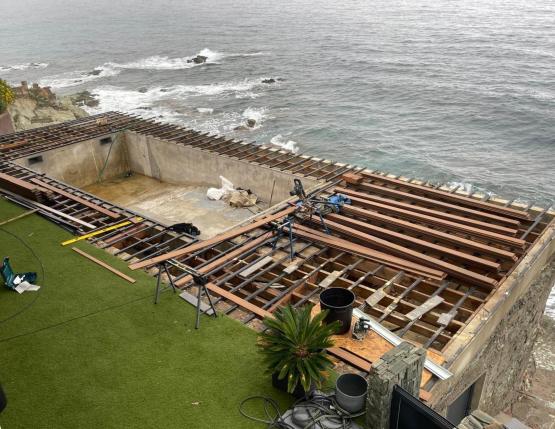
A composite deck is visible. But it's what you don't see that makes all the difference. Silvadec® composite deck boards must never rest directly on the ground: they must necessarily rest on joists, those structural pieces that guarantee ventilation, stability and durability of the whole system.
Good news: Silvadec has designed two families of joists suited to all types of substrates. Whatever your project configuration — concrete slab, adjustable pedestals, deck over waterproofing — there is a solution designed to last.
Common rules to observe, regardless of joist type
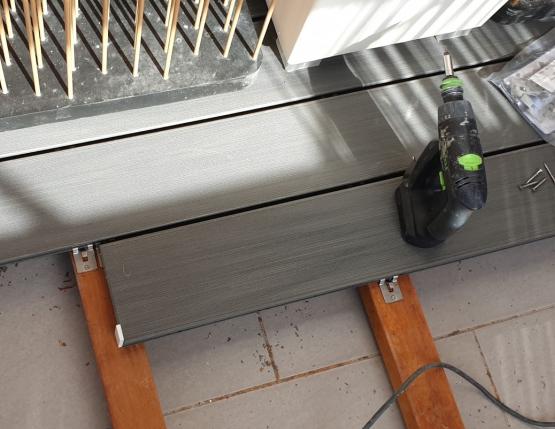
Before choosing your joist type, certain principles apply to all installation cases. The free height between the ground and the underside of the boards must be at least 50 mm, to ensure adequate ventilation beneath the deck. Joists must have a minimum width of 40 mm and be installed at a maximum spacing of 400 mm center-to-center. It is also prohibited to install any mesh, felt or geotextile over the joists, at the risk of obstructing ventilation. Finally, the ends of each board must necessarily rest on a joist, with an overhang not exceeding 25 mm.
The Silvadec® composite joist: ideal for installation on concrete slabs
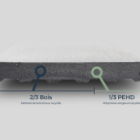
Manufactured from the same composite as the deck boards — 2/3 French wood flour, 1/3 high-density polyethylene — the Silvadec® composite joist is the natural solution for installation on flat concrete slabs. Rot-proof and maintenance-free, it perfectly fits the logic of a 100% composite deck.
Installation conditions to observe absolutely
The Silvadec® composite joist is a non-structural element: it must necessarily rest over its full length on a solid, level surface (concrete slab or compacted ground with bearing pads integrated into the ground). It must not be used on pedestals, pilings or directly over a waterproofing membrane. It must not stand in water. Cutting is only permitted lengthwise — never in thickness or width.
Characteristics and article codes
|
Article code |
Description |
Dimensions (mm) |
Colour |
|---|---|---|---|
|
SILAMB1501 |
Grey joist 3000 mm |
50 × 50 × 3000 |
Anthracite grey |
|
SILAMB1102 |
Grey joist 4000 mm |
50 × 50 × 4000 |
Anthracite grey |
Available in Anthracite grey colour, the composite joist blends discreetly beneath the decking. It is installed perpendicular to the boards, in the slope direction to promote water runoff.
The Réversil Silvadec® aluminium joist: the all-terrain structural solution
Designed for demanding configurations, the Réversil Silvadec® aluminium joist is the technical answer to situations where the composite joist reaches its limits. Installation on adjustable pedestals, on shims, over waterproofing, in humid environments or at height: this is the domain of this heat-lacquered black matte aluminium profile.
A reversible profile with multiple advantages
The name Réversil is not arbitrary. This profile can be flipped to allow two boards to meet on a single joist, thanks to two rails positioned on its underside. Oriented one way, it houses standard fixing clips for standard installation; flipped, it distributes the meeting joint over two distinct rails. A worthwhile saving in material and time on large surfaces.
Another strong point: the clip rail is slightly deeper than the clip itself, which means that the deck boards rest directly on the joist and not on the metal piece. Result: remarkable sound dampening, without clicking or resonance.
A complete system, designed for the installer
The Réversil joist has been designed as a complete ecosystem. It is supplied and marketed with a dedicated range of accessories that guarantee the flatness and solidity of the structure: foldable connectors for lengthwise connections, horizontal and vertical brackets for assemblies, flat and toothed shims for height adjustment, and rubber pads for ground isolation. Screws and clips are guided by rails and centerlines integrated into the profile, which secures and accelerates installation.
Installation rules on pedestals
The spacing between pedestals must observe a maximum of 600 mm for private installations and 400 mm for public access buildings. The authorized overhang at the end of the joist is limited to 150 mm. Each pedestal must be secured to the joist, ideally using pedestals equipped with fixing brackets. For long lengths, joists connect using foldable connectors, taking care that each end is supported by a pedestal.
For installing a Silvadec deck, please consult our assembly instructions.
Technical characteristics
|
Reference |
Dimensions (mm) |
Material |
Finish |
Colour |
Weight |
|---|---|---|---|---|---|
|
SILAMB2102 |
63 × 40 × 3600 |
Aluminium |
Heat-lacquered |
Matt black |
3.23 kg |
10-year warranty. 100% recyclable through standard aluminium recycling channels. Download assembly instruction PU39.
Which joist to choose according to your configuration?
|
Substrate type |
Recommended joist |
Installation guide |
|---|---|---|
|
Flat concrete slab, compacted ground with integrated shims |
Silvadec® composite joist 50 × 50 mm |
|
|
Polymer pedestals, adjustable pedestals, pilings, foundation screws |
Réversil Silvadec® aluminium joist |
|
|
Waterproofing, roof deck, humid environment |
Réversil Silvadec® aluminium joist |
|
|
Height adjustment shims (reduced height impossible on pedestals) |
Réversil Silvadec® aluminium joist with rubber pads and shims |
View the complete range of deck accessories
For any mixed or atypical configuration (diagonal deck, angles other than 90°, access under structure required), our sales team and our distribution network are at your disposal to advise you.